Flat Roof Replacement & Repair Costs in Northern Virginia
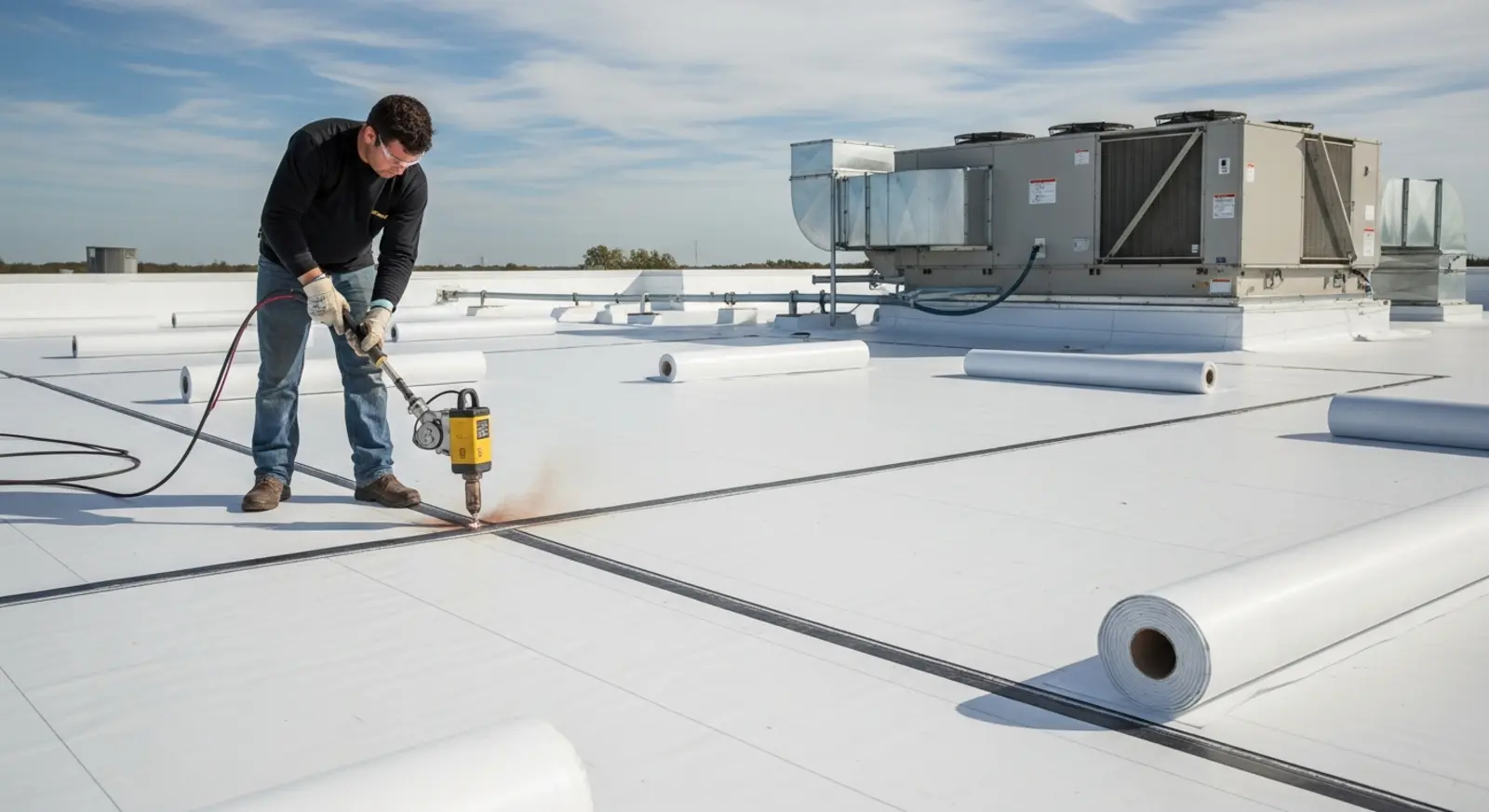
TPO flat roof replacement in Northern Virginia typically runs $6.50–$10 per sq ft installed in 2026. EPDM brackets that range on the lower end at $5.50–$9 per sq ft; PVC brackets it on the high end at $8–$12 per sq ft. When an existing membrane qualifies — the deck and insulation are dry and the membrane is structurally intact — silicone coating is a mid-life option at $2.50–$5 per sq ft. These are typical Northern Virginia planning ranges; your specific cost is confirmed at a free inspection.
2026 FLAT ROOF PRICING
Flat Roof Membrane Prices Compared (2026)
Flat roofing in Northern Virginia is dominated by three single-ply membrane systems: TPO, EPDM, and PVC. Each handles the region’s freeze-thaw cycles, summer heat loads, and summer thunderstorm intensity well — the differences are in reflectivity, chemical resistance, installation method, and cost. TPO is the most common choice for commercial buildings because of its white reflective surface and mid-range price point. EPDM (rubber roofing) is the classic budget-friendly option with a long track record. PVC is the premium option for buildings with grease exposure, chemical exhausts, or demanding ponding conditions.
All three systems require a qualified installer and a compatible insulation package to achieve their rated lifespans. A 60-mil membrane installed correctly over correctly specified polyiso insulation performs very differently from a 45-mil membrane installed over wet or undersized insulation — specify the membrane thickness and insulation R-value in any estimate you receive.
| Membrane | Per Sq Ft | Typical Lifespan | Best For |
|---|---|---|---|
| TPO | $6.50–$10 | 20–30 years | Most commercial, reflective energy savings |
| EPDM | $5.50–$9 | 20–30 years | Budget, simple roofs, proven track record |
| PVC | $8–$12 | 25–35 years | Restaurants, grease exposure, chemical resistance |
Typical Northern Virginia ranges for planning purposes only. Final pricing confirmed at your free inspection. Prices vary with roof size, insulation package, access, and decking condition.
COATING VS REPLACEMENT
Coat It or Replace It?
A silicone roof coating applied to a qualifying flat membrane costs roughly $2.50–$5 per sq ft — 40–60% of what a full replacement runs. If your building qualifies, coating is one of the most cost-effective maintenance decisions in commercial roofing. The savings compound: a quality coating adds 10–15 years to an existing membrane and can itself be recoated at end of life, extending the total service life without another full tear-off.
The critical prerequisite is that the existing system must be in the right condition. Coating is viable when the deck and insulation beneath are dry, the membrane is structurally intact, and seams are sound or can be reinforced before coating. A membrane with widespread seam failure, delamination, or subsurface moisture is not a coating candidate — coating over wet insulation locks the moisture in and accelerates decay.
The decision is made by inspection, not by age or appearance alone. We use infrared and non-destructive moisture scanning to map subsurface moisture before recommending any scope. A roof that looks worn on the surface may have perfectly dry insulation underneath and coat well. A roof that looks intact may have a hidden moisture pocket from a single failed penetration. You need the scan data before committing to either path.
See our silicone roof coating service page for coating process details, or our flat and TPO roofing page for full replacement scope.
COMMERCIAL PRICING
What Commercial Buildings Typically Pay
Commercial flat roofing is priced the same way as residential — per sq ft of installed membrane — but commercial buildings are typically larger, which means the absolute numbers are higher and the stakes of a wrong membrane choice are higher. The following are illustrative typical-range scenarios computed directly from the per-sq-ft ranges above. They are not quotes, not job histories, and not representations of any specific project.
- 6,000 sq ft retail strip, TPO replacement: $6.50–$10 × 6,000 = $39,000–$60,000 typical range. TPO is the standard choice here for its reflectivity and Heat Island compliance in many Virginia jurisdictions.
- 2,500 sq ft restaurant addition, PVC replacement: $8–$12 × 2,500 = $20,000–$30,000 typical range. PVC’s resistance to grease and cooking exhaust makes it the correct membrane where kitchen vents are present.
- 4,000 sq ft office/warehouse addition, EPDM replacement: $5.50–$9 × 4,000 = $22,000–$36,000 typical range. EPDM is cost-effective for low-traffic sections with simple geometry and no chemical exposure.
Insulation package, drainage corrections, edge metal, and penetration count all affect the final number. Get a scoped, itemized estimate before committing to any commercial flat roofing project.
WHAT DRIVES PRICE
What Changes the Price
Two flat-roof quotes on buildings of identical size can diverge by $15,000 or more. These five variables explain most of that gap:
- Insulation package. Building-code requirements for flat-roof R-value vary in Northern Virginia jurisdictions, but most commercial projects require multiple layers of polyiso rigid insulation. Polyiso is priced per board foot and represents a significant portion of total installed cost — particularly on older buildings where existing insulation must be removed and replaced rather than recovered.
- Tear-off vs. recover. Recovering (installing new membrane over the existing one) is permitted in some jurisdictions for one layer and saves significant labor. However, recover masks existing insulation damage and is only appropriate when moisture scanning confirms dry substrate. Tear-off adds $1–$2 per sq ft but gives full access to the deck and insulation.
- Penetrations and HVAC curbs. Every pipe, conduit, exhaust vent, and HVAC curb that penetrates the membrane requires custom flashing. On commercial roofs with heavy mechanical equipment, penetration count can be 30–50+ on a single building. Each one is a labor-intensive detail that adds meaningfully to the total installed cost.
- Edge metal and parapet details. Copings, gravel stops, and drip edges are often in poor condition on older flat roofs. Replacing edge metal adds $10–$20 per linear foot — on a large commercial building with 400+ linear feet of perimeter, this is a material line item in the estimate.
- Drainage corrections. Ponding water is the leading cause of premature flat-roof failure. Correcting slope deficiencies through tapered insulation or adding internal drains is often the highest-value investment in a flat roof project — it can add $1.50–$4 per sq ft but substantially extends the life of the new membrane.
Get a Written Flat Roof Estimate
We serve both commercial and residential flat roofs across Northern Virginia — TPO, EPDM, PVC, and silicone coatings. Call (571) 538-9995 or book online. See our commercial roof installation service page for scope and process details.
Book Your Free InspectionFAQ
Flat Roof Cost FAQs
How long does a TPO roof last in Virginia? +
A properly installed TPO membrane in Northern Virginia lasts 20–30 years with routine maintenance. The critical items are annual inspection of seams and penetrations, keeping drains clear of debris, and addressing any blistering or seam separation before it develops into an active leak. Ponding water is the main enemy — standing water accelerates membrane degradation and, once it infiltrates the insulation below, typically forces a full replacement rather than a targeted repair. A 60-mil membrane installed by a certified contractor and maintained consistently will typically reach the upper end of that range.
Is TPO or EPDM cheaper? +
EPDM is typically the less expensive option upfront — roughly $5.50–$9 per sq ft installed in Northern Virginia versus TPO’s $6.50–$10 range. For a simple low-traffic flat roof where upfront cost is the primary driver, EPDM is a solid, proven choice with a 20–30 year lifespan. TPO’s white reflective surface reduces cooling loads on commercial buildings during Northern Virginia’s humid summers — on large roofs, that operational savings can meaningfully offset the higher material cost over time. We evaluate both systems against your specific building, use, and budget.
Can a flat roof be repaired instead of replaced? +
Yes — isolated damage such as a punctured membrane, a separated seam, or a failed drain collar can almost always be repaired without full replacement when the surrounding insulation is dry. The determining factor is moisture in the insulation layer below the membrane: if water has infiltrated and saturated the polyiso or cover board, a surface repair will not hold long-term — the wet material must come out. We use non-destructive moisture scanning before recommending any scope of work, so you know exactly what you’re dealing with before committing to a repair or a full tear-off.